
Easy Sandwich Bread Recipe
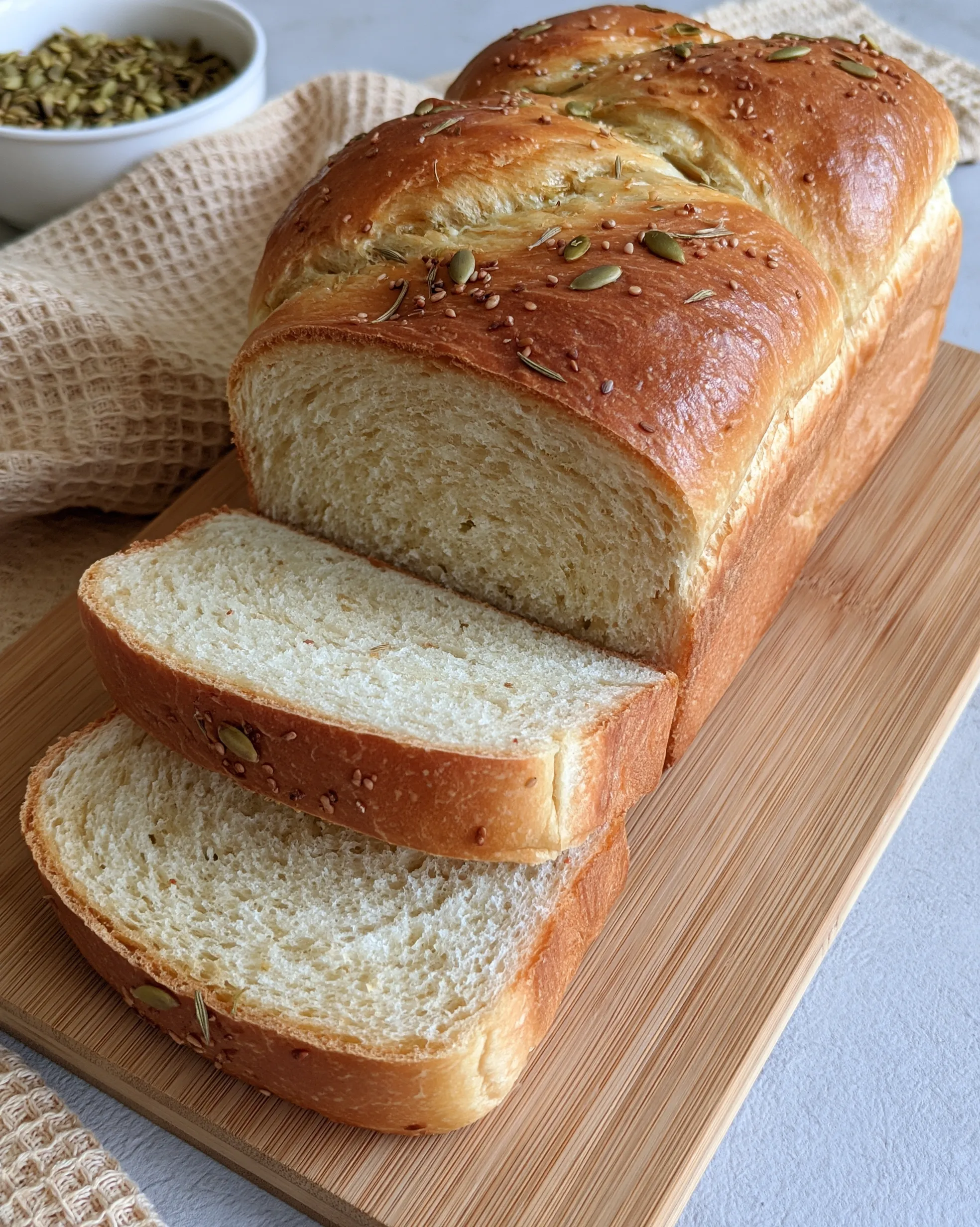
There is a moment, about ten minutes after this loaf comes out of the oven, when the whole kitchen smells like a bakery and the crust is still crackling as it cools. That moment is exactly why this sandwich bread recipe has earned a permanent spot in my kitchen. One slice of this tall, soft loaf — glossy golden crust, a scatter of crunchy seeds on top, cloud-soft crumb — and the squishy store-bought kind is hard to go back to.
And it is genuinely easy. No starter, no overnight fuss, no special equipment beyond a loaf pan. You mix simple pantry ingredients, knead until the dough turns silky, and let time do most of the work. The little twist I shape into the top is not just pretty — it gives the loaf that beautiful bakery-style ridge you see in the photo. Slice it thick for sandwiches, thin for toast, or tear into a warm end piece with salted butter. Every option is a good one.
Why Homemade Sandwich Bread Beats the Store Loaf
- Tall, soft slices that actually hold a sandwich — no tearing, no soggy collapse, just a fine, tender crumb from edge to edge.
- That glossy, seed-crusted top — a quick brush of milk and a sprinkle of pumpkin and sesame seeds give the photo finish and a little crunch in every bite.
- Pantry ingredients only — flour, milk, honey, yeast, butter, one egg. Nothing you cannot pronounce.
- Costs pennies per loaf and freezes beautifully, so homemade bread can be an everyday thing, not a weekend project.
- Your house will smell incredible — this alone might be reason enough.
The Ingredients (Pantry Basics Only)
- 1 cup (240 ml) warm whole milk — warm means 105–110°F (40–43°C), like a warm bath. Hotter than that can kill the yeast; colder and the dough rises at a crawl.
- 1/4 cup (60 ml) warm water — together with the milk, this gives a soft, high-rising dough.
- 2 tablespoons honey — or granulated sugar. It feeds the yeast and gives the crust its deep golden color.
- 2¼ teaspoons instant yeast — one standard 7 g packet. Active dry yeast works too; just let it bloom in the warm liquid for a full 10 minutes.
- 3½ cups (445 g) bread flour, plus up to 1/4 cup more if needed — bread flour’s extra protein is what builds the tall, sliceable structure. All-purpose flour works in a pinch (see the FAQs).
- 1 large egg, at room temperature — my secret for a rich, soft crumb that stays fresh-tasting for days.
- 3 tablespoons unsalted butter, softened — worked into the dough for flavor and tenderness. Oil can replace it, but butter tastes better.
- 1½ teaspoons fine salt — do not skip it; unsalted bread dough tastes flat no matter how good the flour is.
- For the top: 1 tablespoon milk, for brushing, plus 1½ tablespoons mixed seeds — I use about 1 tablespoon pumpkin seeds and 1½ teaspoons sesame seeds, just like the photo.
How to Make It: Mix, Knead, Rise, Bake
- Wake up the yeast. Whisk the warm milk, warm water, honey and yeast in a large bowl (or the bowl of a stand mixer). Rest 5 minutes, until foamy on top. Even instant yeast benefits from this quick proof — you know it is alive before you commit your flour.
- Build the dough. Add the flour, egg and salt. Mix to a shaggy dough, then drop in the softened butter a few pieces at a time, mixing after each addition.
- Knead until silky. Knead 8 to 10 minutes by hand (6 to 7 minutes with a dough hook on medium-low) until the dough is smooth, elastic and only slightly tacky. Stretch a small piece thin — if it stretches without tearing until you can almost see light through it, you have hit the windowpane stage and you are done. If the dough is very sticky, knead in extra flour a tablespoon at a time.
- First rise. Place the dough in a lightly oiled bowl, turn once to coat, cover, and rise in a warm spot for 1 to 1½ hours, until doubled in size.
- Shape the twist. Tip the dough onto a lightly floured surface and divide it in half. Roll each half into a rope about 12 inches (30 cm) long. Lay the ropes side by side, twist them around each other, and pinch the ends to seal. Lift the twist into a greased 9×5-inch (23×13 cm) loaf pan, tucking the ends underneath. (In a hurry? Roll the whole piece of dough into one snug log instead — it will still be delicious.)
- Second rise. Cover and rise 35 to 45 minutes, until the dough crowns about 1 inch above the rim of the pan. Meanwhile, heat the oven to 350°F (175°C).
- Brush, sprinkle, bake. Gently brush the top with the tablespoon of milk — a heavy hand can deflate the loaf, so be light. Scatter the mixed seeds over the top. Bake 30 to 35 minutes, until the crust is a deep, glossy golden brown and the center of the loaf reads 190°F (88°C) on a thermometer. If the seeds brown too fast, tent foil loosely over the top for the last 10 minutes.
- Cool completely before slicing. Turn the loaf out onto a rack right away. Wait at least 1 hour before you cut in — the crumb is still setting as it cools, and slicing early makes even perfect bread turn gummy.
Sofia’s Expert Tips (Tall, Soft Slices)
- Mind the milk temperature. This is where most first loaves fail. If the liquid feels hot rather than warm on your wrist, let it cool. Yeast starts dying above 120°F (49°C) and is gone by 140°F.
- Soft dough, soft bread. Resist the urge to keep adding flour. A slightly tacky dough that cleans the bowl as it kneads is exactly right — a dry, stiff dough bakes into a dry, dense loaf.
- The second rise is not optional. An under-proofed loaf bursts or cracks along the side in the oven and slices dense. Wait until it crowns a full inch above the pan rim; the twist needs that time to set its shape.
- Brush with milk, not egg, for this look. Milk gives the gentle shine and helps the seeds stick without the deep mahogany color of an egg wash — closer to the soft golden crust in the photo. For an extra-glossy finish, brush the hot loaf with a little melted butter the moment it comes out.
- Slice with a serrated knife and a light touch. Let the knife’s teeth do the work in long strokes instead of pressing down, and you will get clean, even slices that do not squash.
- Cooling is part of baking. That hour on the rack finishes the crumb. If the inside still feels tacky when you slice, it needed cooling time, not more oven time.
Easy Variations Worth Trying
- Honey whole wheat: swap half the bread flour for whole wheat flour and add 1 extra tablespoon of honey. Heartier, slightly nutty, still soft.
- Garlic herb loaf: skip the seeds; brush the baked loaf with garlic butter and a pinch of flaky salt. Unbeatable next to soup or pasta.
- Cinnamon swirl: roll the dough into a rectangle, brush with melted butter, sprinkle with 1/3 cup sugar mixed with 2 teaspoons cinnamon, roll up tight and bake as a single log. Breakfast toast, upgraded.
- Dinner rolls: divide the dough into 12 balls instead of a loaf, proof in a greased 9×13-inch pan, brush with milk, add the seeds, and bake 18 to 20 minutes.
How to Store, Freeze and Reheat It
- Counter: once fully cool, keep the loaf (whole or sliced) in a sealed bag or bread box at room temperature for up to 3 days. Skip the fridge — refrigerating bread makes it stale faster.
- Freezer: slice the whole loaf first, then freeze in a sealed bag with a small square of parchment between slices, for up to 3 months.
- Reheat: frozen slices go straight into the toaster — that is the whole system, and it works perfectly. For a warm, fresh-baked feel, wrap the unsliced loaf in foil and warm at 300°F (150°C) for 10 minutes.
FAQs
Yes. The loaf will be slightly less tall and a touch less chewy, but still soft and sliceable. All-purpose flour absorbs a little less liquid, so hold back a spoonful or two of the milk at first and add it only if the dough feels stiff.
Yes — replace the egg with 2 extra tablespoons of warm milk. The crumb will be a little less rich and the loaf keeps for about a day less, but it still rises beautifully. Brush the top with milk as usual so the seeds stick.
That is almost always an under-proofed second rise: the dough still had too much energy left and expanded violently in the oven (called oven spring). Next time, let the dough crown a full inch above the pan rim before baking, and make sure your oven is fully preheated so the rise is even.
Yes, two ways. Either knead the dough, cover, and refrigerate it overnight instead of the first rise — let it sit at room temperature for 30 minutes before shaping the next day — or shape the loaf, cover the pan, and refrigerate overnight, then proof at room temperature for about 45 minutes before baking. Both give great flavor.
The most reliable test is temperature: 190–195°F (88–91°C) in the center. The crust should be deep golden, and the loaf should sound hollow when you tap the bottom. If you have no thermometer, bake the full 35 minutes and never slice before the loaf has cooled for an hour — warm crumb feels gummy even when the bake is perfect.
Easy Sandwich Bread Recipe
Course: BreakfastsCuisine: AmericanDifficulty: Easy12
slices20
minutes35
minutes2
hours40
minutesA tall, soft homemade sandwich loaf with a fine fluffy crumb, a glossy golden crust and a crunchy sprinkle of pumpkin and sesame seeds. Simple ingredients, one easy twist to shape it, perfect slices every time.
Ingredients
1 cup (240 ml) warm whole milk
¼ cup (60 ml) warm water
2 tbsp honey
2¼ tsp instant yeast
3½ cups (445 g) bread flour, plus up to ¼ cup more if needed
1 large egg, room temperature
3 tbsp unsalted butter, softened
1½ tsp fine salt
For the top: 1 tbsp milk for brushing plus 1½ tbsp mixed seeds (about 1 tbsp pumpkin seeds and 1½ tsp sesame seeds)
Directions
- Whisk warm milk, water, honey and yeast; rest 5 minutes until foamy.
- Add flour, egg and salt; mix, then work in the softened butter piece by piece.
- Knead 8–10 minutes (6–7 with a dough hook) to the windowpane stage.
- Rise in an oiled bowl 1–1½ hours until doubled.
- Divide, roll two 12-inch ropes, twist together, place in a greased 9×5-inch loaf pan.
- Rise 35–45 minutes until crowning 1 inch above the rim; preheat oven to 350°F (175°C).
- Brush with milk, sprinkle seeds; bake 30–35 minutes until deep golden and 190°F (88°C) inside.
- Turn out onto a rack and cool at least 1 hour before slicing.
Notes
- Liquid temperature matters — keep the milk and water at 105–110°F (40–43°C) so the yeast stays alive. Knead to the windowpane stage for the tallest loaf, and let the shaped dough crown 1 inch above the pan before baking. Brush with milk (not egg) for the soft golden shine in the photo, and cool a full hour before slicing.
Save this recipe and bake it once — after that first warm slice with butter, the store-bought loaf never stands a chance.
More recipes you’ll love: Easy Bread for Beginners Recipe, Easy Pita Bread Recipe and Easy Garlic Bread Recipe.


